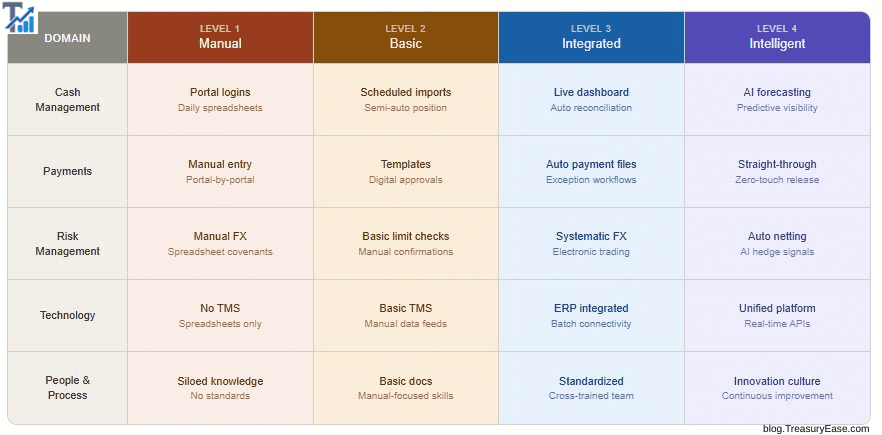
Most treasury teams believe they are more automated than they actually are. They have a TMS, maybe some bank connectivity, and a few Excel macros that someone built years ago. They call it “partially automated.” In reality, the daily work still runs on manual effort, tribal knowledge, and a shared folder full of spreadsheets no one fully understands.
The Treasury Automation Maturity Model exists to cut through that self-assessment bias. It gives you a structured framework to evaluate where you actually stand, not where you think you stand, and what it would take to move forward.
What Is a Maturity Model and Why Does Treasury Need One?
A maturity model is a diagnostic tool. It maps a function across defined levels of capability, from fully manual to fully optimized. In treasury, this matters because automation is not binary. You are not either manual or automated. You are somewhere on a spectrum, and different areas of your function sit at different points on that spectrum at the same time.
Your cash positioning might be real-time and automated. Your FX exposure identification might still be someone pulling data from three different bank portals and pasting it into a spreadsheet every Monday morning. A maturity model surfaces that inconsistency and helps you prioritize where to invest effort.
The Five Domains of Treasury Automation
The model covers five distinct areas of the treasury function:
Cash Management includes bank statement retrieval, cash position reporting, bank reconciliation, and cash flow forecasting. This is where most teams have the widest gap between perceived and actual automation.
Payments covers the full payment lifecycle: creation, approval workflow, release, controls and compliance screening, and reconciliation. Many teams have digitized approval signatures but still manually route files and release payments through individual bank portals.
Risk Management covers FX exposure identification, hedge execution and confirmation, covenant and policy compliance, and counterparty risk monitoring. This area is frequently the least automated, relying almost entirely on spreadsheets and manual calendar-based checks.
Technology Infrastructure assesses your TMS, ERP integration, banking connectivity, and data analytics and reporting capability. Having a TMS does not automatically mean you have integration. Batch file transfers with manual processing is not the same as real-time automated connectivity.
People and Process covers process documentation, staff technology skills, process standardization, change management capability, and cross-training. This dimension is the one most teams skip entirely in automation assessments. It is also the one that determines whether automation projects succeed or fail.
The Four Maturity Levels
Level 1: Manual Treasury. Every process runs on individual effort, bank portal logins, spreadsheet compilation, and manual data transfer. Nothing talks to anything. Knowledge lives in people, not systems. This is not a legacy problem. This is still the reality for a significant number of treasury teams in mid-market and even large corporates.
Level 2: Basic Automation. Some bank statement downloads are scheduled. There is a basic TMS with limited functionality. Approvals are digital but routing is still manual. Reporting has some automation but distribution is manual. Processes are documented in places but not consistently followed. The team has basic system skills. This is the most common level. It looks like progress but the efficiency gains are marginal because the integrations are not complete.
Level 3: Integrated Automation. Systems are connected. ERP integration runs via batch or real-time feeds. Payment files are generated automatically from source systems. Cash position is available on a dashboard without manual input. FX exposures are collected systematically. Reconciliation has automated matching with exception-based workflows. The team understands the technology and processes are standardized across entities.
Level 4: Intelligent Treasury. Real-time cash visibility across all accounts and entities. Fully automated payment factory with straight-through processing. AI-assisted forecasting with variance analysis. Automated FX exposure netting and hedge recommendations. Proactive covenant and counterparty monitoring with alerts. A TMS that is the single source of truth, fully integrated with ERP and banking. The team drives continuous improvement, not just maintenance.
How to Use This Framework
Do not evaluate your treasury function as a whole. Go domain by domain, process by process. You will almost certainly find that you are a Level 3 in payments and a Level 1 in risk management. That asymmetry is where your roadmap starts.
The goal is not to reach Level 4 everywhere simultaneously. That is not realistic and it is not how automation investments work. The goal is to identify your Level 1 processes and ask one question: what is the cost of keeping this manual for another year?
Where Do You Stand?
If you want a structured answer rather than a self-estimate, the Treasury Automation Maturity Assessment takes five minutes and covers all five domains across 23 specific processes. You receive a personalized PDF with your results and recommendations based on your company size and team structure.
Treasury tech insights. No fluff.
One email per week. Build logs, tools, and opinions from the trenches.
Subscribe →