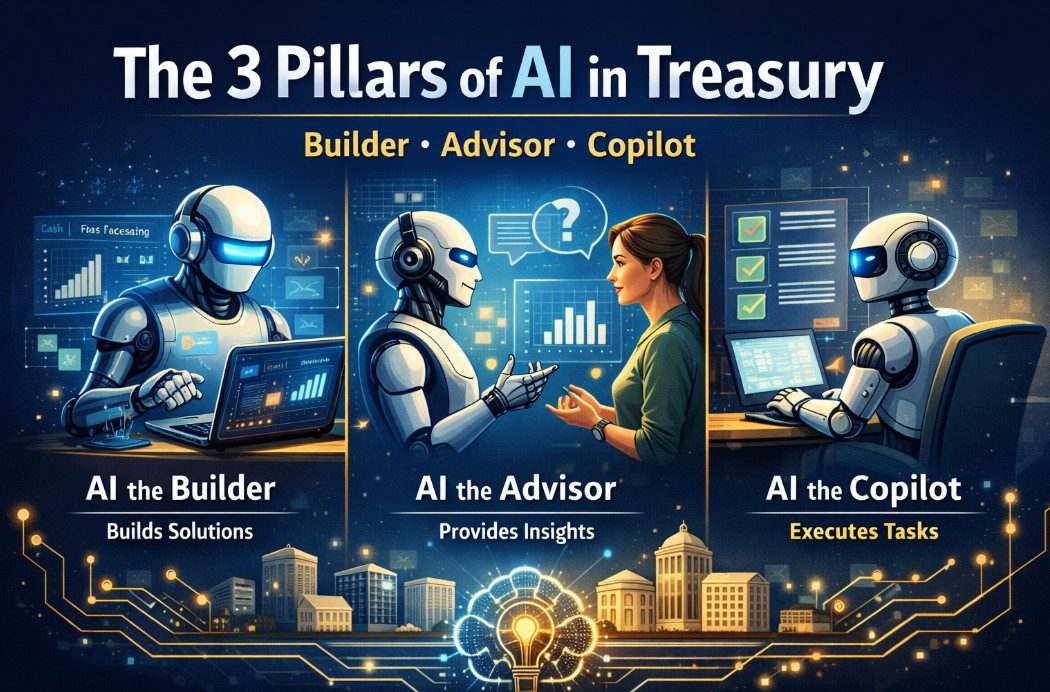
When treasury professionals hear “AI,” most picture one of two things: a chatbot that answers questions or some vague automation that runs in the background.
That mental model is incomplete. And it’s costing teams real productivity.
After 10+ years in treasury (running cash operations, managing bank relationships, building forecasts, and dealing with the eternal wait for IT to deliver something useful) I’ve come to see AI differently. Not as a single tool, but as three distinct modes of working. Each solves a different problem. Each requires a different approach.
Understanding this distinction isn’t academic. It’s the difference between implementing AI that actually helps and implementing AI that becomes another abandoned project.
How We Talk About AI
You read all kinds of things on the internet. But when you get back to your desk and try to apply what you learned, you hit a wall. Because “AI” isn’t a solution, it’s a category. Saying “we need AI in treasury” is like saying “we need software in treasury.” It’s too broad to be useful.
Here’s what I’ve learned building TreasuryOS and watching how treasury teams actually work: AI operates in three fundamentally different modes. Each has its own strengths, limitations, and ideal use cases.
- Mode 1: AI the Builder
- Mode 2: AI the Advisor / Assitant
- Mode 3: AI the Agent / Copilot
Let me break down each one with real examples.
Mode 1: AI That Builds
This is the mode most treasury professionals don’t even know exists.
Builder AI takes your description of what you need and creates it. Not a recommendation. Not a template. An actual working application, report, or workflow.
What This Looks Like in Practice
Let’s talk about cash forecasting, the task that haunts every treasury team.
The traditional process: You need a 13-week cash forecast. Your ERP spits out data in one format. Your banks send statements in another. You have AR and AP projections in spreadsheets that may or may not be current. Someone on your team spends hours every week copying, pasting, reconciling, and formatting this into something presentable.
When you ask IT for a better solution, you get a 6-month timeline and a requirements document that makes you question your will to live. When you ask your TMS vendor, you get a quote that requires budget approval from three levels above you.
Builder AI changes this equation entirely.
You describe what you need: “I need a cash forecast that pulls our bank balances, layers in AP and AR projections, and shows me a 13-week view by entity and currency. I want to see actuals vs. forecast variance and flag anything over 10%.”
The AI builds it. Not a mockup. A working application.
This isn’t science fiction. Right now, inside TreasuryOS, cash forecasting is the most common application users are building. Because it’s the pain point that hurts most and that traditional solutions have failed to address for years. It’s not perfect, but at least it’s easy to build, rapid and it doesn’t make you wait more than 10 minutes.
When Builder AI Makes Sense
Builder AI is your answer when:
- You need something custom that doesn’t exist off the shelf
- The wait time for IT or vendor solutions is measured in months
- Your requirements are clear enough to describe but complex enough that Excel isn’t cutting it
- You need to iterate quickly, build something, test it, improve it
Builder AI is NOT your answer when:
- You need a one-time analysis (use Advisor mode instead)
- Your process is already working and just needs to run faster (use Agent mode)
- You can’t articulate what you need (AI can’t read minds…)
The Mindset Shift
The hardest part of Builder AI isn’t the technology. It’s the mental shift.
Treasury professionals are trained to be users of systems, not builders of systems. We log into our TMS. We export from our ERP. We receive what IT gives us.
Builder AI inverts this. You become the architect. The question changes from “what does my vendor offer?” to “what do I actually need?”
That’s uncomfortable at first. It’s also incredibly powerful once you embrace it.
Mode 2: AI That Advises
This is the mode most people think of when they hear “AI in treasury” and honestly, it’s the most intuitive.
Advisor AI answers questions, analyzes situations, and provides recommendations. Think of it as having a knowledgeable colleague available 24/7 who has read every treasury policy, IFRS standard, and market update.
What This Looks Like in Practice
A few scenarios where Advisor AI shines:
Policy Interpretation
You’re reviewing a counterparty and need to check if they meet your investment policy requirements. Instead of digging through a 40-page policy document, you ask: “Does this counterparty with a BBB+ rating and 18-month maturity fit within our investment policy?”
The AI parses your policy, checks the parameters, and gives you a direct answer with the specific policy sections referenced.
Decision Support
You’re considering hedging a EUR exposure for Q2. You want to think through the implications. You ask: “Given current EUR/USD volatility, what are the tradeoffs between a forward contract and an option strategy for a €5M exposure over 90 days?”
The AI walks you through the considerations—cost, flexibility, accounting treatment, worst-case scenarios. Not making the decision for you, but giving you the structured analysis to make it yourself.
Training and Onboarding
A new analyst joins your team and asks what “in-house banking” means and how your company uses it. Instead of spending an hour explaining, they ask the AI, which provides context specific to your organization’s setup.
When Advisor AI Makes Sense
Advisor AI is your answer when:
- You need analysis or interpretation, not action
- The question requires synthesizing multiple sources of information
- You want to think through scenarios without committing to anything
- You’re training or onboarding team members
Advisor AI is NOT your answer when:
- You need something done, not explained
- The task is repetitive and should be automated
- You need a new tool or report built
The Limitation
Advisor AI is only as good as the context it has.
A generic AI assistant that knows treasury concepts but doesn’t know YOUR policies, YOUR bank setup, YOUR entity structure, that’s a parlor trick. It can answer textbook questions, but it can’t answer YOUR questions.
This is why I built TreasuryOS with context awareness at its core. The Assistant knows your setup because it’s connected to your data. When you ask about your cash position, it’s not guessing—it’s looking at your actual numbers.
Mode 3: AI That Executes
This is where AI stops being a tool you interact with and starts being a worker that operates alongside you.
Agent AI performs tasks autonomously. You define the rules, set the triggers, and the AI handles execution: monitoring, processing, escalating when needed.
What This Looks Like in Practice
Let’s talk about reconciliation, specifically, why “fuzzy matching” isn’t the answer.
Traditional reconciliation automation uses fuzzy matching: if a payment roughly matches an invoice (amount within tolerance, similar reference number), it marks them as matched. Sounds good until you realize:
- Fuzzy matching still leaves you with a pile of exceptions to review manually
- It can’t understand context: why a payment is split, why an amount differs, what a cryptic reference actually means
- It’s brittle: change your payment formats or bank switch and your matching rules break
Agent AI approaches reconciliation differently. Instead of pattern matching, it understands.
Example: A payment comes in for €47,892. There’s no exact invoice match. Traditional automation flags it as an exception and moves on. An AI agent looks deeper: there’s an invoice for €48,000 with a 2.25% early payment discount. The timing matches the discount terms. The reference contains the customer’s internal code. The agent matches them, logs the reasoning, and you only see it in your audit trail. That’s smart reconciliation. Not fuzzy—intelligent.
Beyond Reconciliation
Agents aren’t limited to reconciliation. Here’s where treasury teams are finding value:
Cash Position Monitoring
An agent watches your bank balances throughout the day. When cash in your EUR operating account drops below a threshold, it doesn’t just alert you, it drafts the intercompany transfer request and queues it for your approval.
Payment Anomaly Detection
Before payments go out, an agent reviews them against historical patterns. A vendor payment that’s 3x the usual amount gets flagged. A payment to a new bank account triggers verification. You’re not reviewing every payment, just the ones that need human judgment.
Report Generation
At 7 AM every Monday, an agent pulls your weekly cash report, formats it for the CFO, and drops it in their inbox. You stopped doing this manually months ago.
When Agent AI Makes Sense
Agent AI is your answer when:
- The task is repetitive with clear rules
- You need it done consistently without human intervention
- The volume is high enough that manual processing doesn’t scale
- You want humans focused on exceptions, not routine work
Agent AI is NOT your answer when:
- Every case requires human judgment
- The rules aren’t clear or stable
- You’re still figuring out what the process should be (use Builder mode first)
The Trust Question
The biggest barrier to Agent AI isn’t technology, it’s trust.
Treasury professionals are trained to verify everything. The idea of an AI executing tasks autonomously makes people nervous. What if it makes a mistake?
Here’s my honest answer: it will make mistakes. So do humans. The question isn’t “will it be perfect?” but “will it be better than the current process?”
If an agent handles 95% of reconciliations correctly and flags the rest for review, you’ve freed up hours of analyst time for higher-value work. That’s not perfection. That’s progress.
The key is visibility. You need to see what agents are doing, why they made decisions, and where they’re uncertain. Black-box automation that just tells you “done” isn’t trustworthy. Transparent agents that show their reasoning are.
Why Choose One When You Need All Three?
Here’s the insight that led me to build TreasuryOS:
Most AI tools force you into one mode. You get a chatbot (Advisor). Or you get an automation platform (Agent). Or you get a no-code builder (Builder). But treasury work doesn’t fit neatly into one category.
On Monday morning, you need an Agent running your cash position report before you arrive. By 10 AM, you’re asking an Advisor to help you interpret a new hedge accounting rule. After lunch, you realize you need a new dashboard that doesn’t exist, so you need a Builder.
Same treasurer. Same day. Three different AI modes.
This is why TreasuryOS isn’t a chatbot or an automation tool or a builder. It’s all three, working together. Because that’s how treasury actually works.
Where Do You Start?
If you’re a treasury professional trying to figure out where AI fits in your work, here’s my practical advice:
Start with your biggest time sink. What task do you or your team dread? What eats hours every week that feels like it should be automated? That’s your entry point.
Match the task to the mode:
- If you need something that doesn’t exist → Builder
- If you need answers and analysis → Advisor
- If you need routine work done automatically → Agent
Start small. Don’t try to transform everything at once. Pick one process, implement one AI mode, prove it works, then expand.
Demand transparency. Whatever AI you use, you should be able to see how it works and why it made decisions. If you can’t, you don’t control it—it controls you.
The Bigger Picture
Treasury has been underserved by technology for decades. We’ve been stuck between enterprise systems that cost millions and take years to implement, and spreadsheets that are flexible but fragile.
AI changes that equation, but only if we understand how to use it.
Builder AI means you don’t wait for vendors. Advisor AI means you have expertise on demand. Agent AI means your team focuses on judgment, not repetition.
That’s not a prediction about the future. That’s what’s happening right now, inside treasury teams that have figured out how to use these tools.
The only question is whether you’ll be one of them.
TreasuryOS is an AI-powered operating system for treasury, combining Builder, Advisor, and Agent capabilities in one platform. If you’re ready to stop waiting for IT and start building what you actually need, visit TreasuryOS – AI-Powered Treasury Platform.
Treasury tech insights. No fluff.
One email per week. Build logs, tools, and opinions from the trenches.
Subscribe →