Everyone’s talking about AI in treasury. Conferences are full of panels about it. Consultants are selling “AI strategy roadmaps.” Vendors are adding “AI-powered” to every feature description.
But when you actually sit down with a treasury team and ask “so, what have you done with AI?”, the answer is almost always the same: nothing yet.
Not because it’s too hard. Because they’re overthinking it.
The Only Questions That Matter
Before you invest in any AI solution, tool, or platform, answer four simple questions for each use case you’re considering:
- Is the data available? Do you actually have the data you’d need, or is it locked in emails, PDFs, and someone’s head?
- Is the data structured? Having data is one thing. Having it clean, categorized, and in a usable format is another.
- Is the process repetitive? AI shines when it automates things you do over and over. One-off strategic decisions? That’s still your job.
- Can you measure the impact? If you can’t say “this saves X hours” or “this reduces errors by Y%”, how will you know it worked?
If you have four “yes” answers, you’re ready. Pick that use case, pick a model, and start.
If you have a “no” on any of these, you don’t have an AI problem. You have a data and process problem. Fix that first.
Where to Start (and Where Not To)
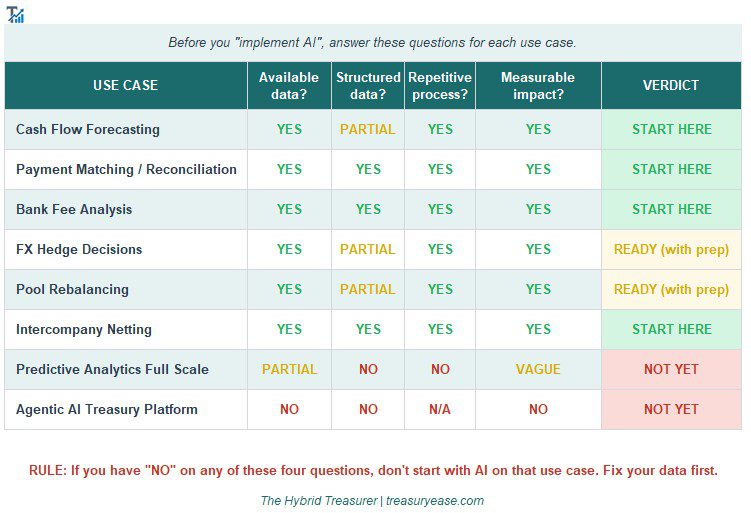
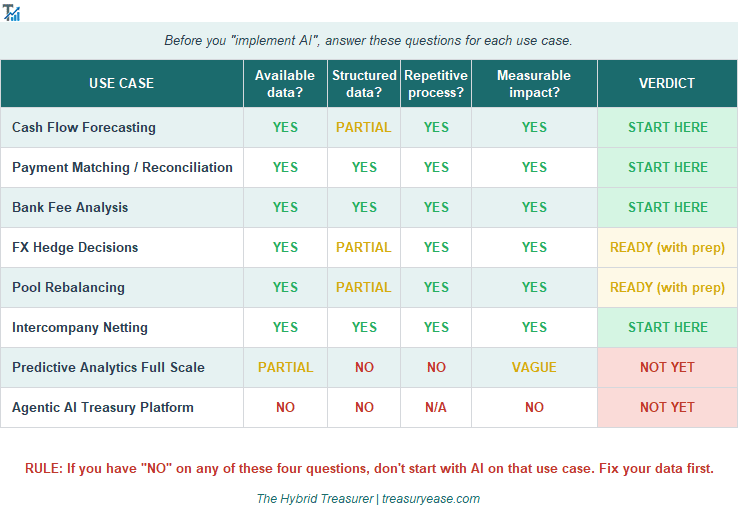
I put together a simple checklist scoring common treasury use cases against these four questions.
The best use cases to start with are the boring ones:
- Payment matching and reconciliation — data exists, it’s structured, you do it every day, and you can measure time saved immediately.
- Bank fee analysis — banks send you structured fee data. Comparing it against contracts is pure pattern matching. Perfect for AI.
- Intercompany netting — repetitive, data-heavy, rule-based. Exactly what AI is good at.
The worst use cases to start with are the exciting ones:
- “Company-wide predictive analytics” — sounds impressive. In practice, you need clean historical data across every entity, standardized categories, and a clear definition of what you’re predicting. Most teams don’t have any of these.
- “Agentic AI treasury platform” — the buzzword of 2026. An autonomous system that connects to your banks, pulls data, classifies transactions, and makes decisions with minimal human input. Technically possible. Practically, nobody’s data is ready for that.
The Real Blocker Is Not Technology
The real reason most treasury teams haven’t started with AI is not that the tools are too complex or too expensive. An API call to Claude or GPT costs cents. ChatGPT Enterprise is already in most corporate tech stacks.
The real blocker is that people skip the fundamentals. They chase the buzzword instead of fixing their data. They want the end state without doing the work to get there.
Start small. One use case. Prove it works. Document what you learned. Then scale.
That’s it. Nothing complicated.
Want to discuss how AI could work for your specific treasury setup? Get in touch.
Treasury tech insights. No fluff.
One email per week. Build logs, tools, and opinions from the trenches.
Subscribe →